Why Delay Is the Ambient Guitarist's Most Important Pedal
Every genre has a defining effect. Blues has overdrive. Psychedelia has fuzz. Ambient and post-rock have delay — and not just as an accessory. Delay is the architecture. It's what turns a Telecaster into a cathedral, what makes a two-note melodic fragment feel like it fills a stadium, what lets Explosions in the Sky build twenty-minute emotional arcs from nothing more than chord voicings and careful timing.
Consider what delay actually does in post-rock: The Edge plays a single-coil Stratocaster into a clean Vox AC30 with a dotted-eighth delay at medium feedback, and the guitar sounds like a shimmering, polyrhythmic texture that no human could pick out manually. Kevin Shields stacks fuzz into delay into reverb until the guitar signal is unrecognizable as a guitar — it becomes weather. Tycho layers analog delay with reverb in the DAW for warm, cinematic instrumental pop that feels like late-afternoon light on water. Explosions in the Sky use long-trail delay to blur the boundaries between two guitars until the rhythm structure dissolves into pure atmosphere.
None of that is achievable with just reverb. Reverb adds space. Delay adds time. When you control time — when you choose how far behind the repeat falls, how many times it regenerates, how much the repeats modulate and shimmer — you control the emotional architecture of the music. That's the distinction ambient and post-rock players feel instinctively, and it's why serious players spend more time choosing and dialing in their delay than almost any other effect on their board.
If you're still building your understanding of how delay fits into a full signal chain, the foundational guide is at Guitar Pedalboard Signal Chain Order. But if you already know delay goes after drive and modulation — and you want to know which specific pedal gets you from "I have a delay" to "I have the delay" — read on.
What Makes a Delay "Ambient-Ready"
Not every delay pedal is built for the ambient and post-rock application. A slapback delay for rockabilly and a long-trail modulated delay for ambient work are built around completely different design priorities. Here's what separates ambient-ready delay from everything else:
Long Maximum Delay Time
Slapback lives at 40–150ms. Rhythmic lead lines live at 200–400ms. Ambient textures need 500ms minimum, with the best pedals reaching 800ms, 1,000ms, or beyond. Long delay times create the trailing wash that defines post-rock — chords that linger for seconds after you've moved to the next voicing, letting the harmonic content of two chords overlap and blur into something neither one was alone.
If the maximum delay time on a pedal is 600ms, you can work with it. If it's 300ms, you're limited to rhythmic applications. Always check the maximum delay time before buying for ambient use.
Modulation
Modulation in a delay circuit applies a slow LFO to the repeat path, creating gentle pitch movement on each echo. The difference between a delay with and without modulation in an ambient context is dramatic: without modulation, stacked repeats can feel flat and mechanical. With modulation — even subtle amounts — the repeats feel organic, slightly unstable, alive. They shimmer rather than stack.
The modulation doesn't need to be dramatic. A rate of 0.5–1Hz with 20% depth adds enough movement to make repeats feel three-dimensional. Push the depth higher and you get the slightly pitch-warped, wobbling character of vintage tape delay. Both are useful; the key is that modulation is present and adjustable.
Tap Tempo
Tap tempo lets you set delay time by tapping a footswitch in time with the music, rather than dialing in exact millisecond values. For live playing, this is close to mandatory. If you're playing at 120 BPM and you want dotted-eighth delay, you can calculate 375ms in your head — but it's much faster to tap the beat and let the pedal compute it. Most tap-tempo delays also offer note subdivision options: whole, half, quarter, dotted-eighth, eighth — so you can tap the tempo and switch rhythmic patterns without recalculating.
For studio work, tap tempo is less critical (you can dial in exact values). For live use, it's the difference between spending the first bar of every song adjusting your delay time and just playing.
Trails (Spillover)
Trails describes what happens when you bypass the delay mid-song. Without trails, the repeats cut off instantly — a jarring silence in a style of music where the whole point is seamless sonic continuity. With trails enabled, the existing repeats decay naturally after bypass, so you can step out of the effect without disrupting the texture you've built.
For ambient and post-rock playing, trails mode isn't optional. It's a fundamental requirement. A delay that cuts dry on bypass can ruin a live performance at the moment you need to strip the sound back to clean.
Stereo Output
Stereo delay — where repeats alternate between left and right channels, or the dry and wet signals split to separate outputs — opens up the spatial dimension that makes ambient guitar recordings feel immersive. Running stereo delay into two amps or two channels of a recording interface creates a wide, enveloping sound that mono delay can't replicate.
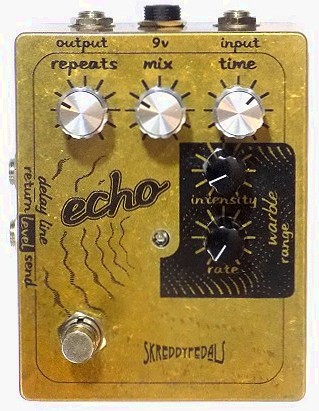
Even for players who run mono live, a stereo-capable delay is worth having for recording. The Strymon TimeLine and Boss DD-500 offer sophisticated stereo modes. The Skreddy Echo's thru jack enables a parallel routing setup that achieves a different kind of spatial separation — the dry signal stays in the amp while the delayed signal routes to a PA or second source simultaneously.
The Pedals
Skreddy Echo — Analog Warmth With a Parallel Architecture
The Skreddy Echo ($338) is the flagship delay from Marc Ahlfs' Carson City, Nevada workshop — the same builder behind some of the most respected fuzz circuits in boutique pedal history. The Echo is analog-voiced: its circuit is designed to produce the warm, high-frequency roll-off that makes BBD-style repeats feel like they're receding into space rather than competing with the dry signal.
What distinguishes the Echo from other analog-voiced delays is the built-in modulation section and the thru jack for parallel routing. The modulation applies organic pitch movement to the repeat path — slow enough to feel natural rather than deliberate, adjustable from subtle shimmer to the kind of tape-flutter instability that defined 1970s studio recordings. The thru jack outputs the dry signal separately, letting you route the unaffected guitar to your amp while the delay signal goes to an XLR output or a second amplifier in parallel. This is a particularly powerful setup for live playing: your fundamental amp tone stays clean and direct while the delay inhabits its own sonic space.
The pedal was featured in Billy Corgan's Premier Guitar interview — an endorsement from a player whose ambient guitar work on Siamese Dream and Mellon Collie defined an era of studio delay use. Corgan's approach to layering clean and delayed guitar signals into dense, orchestral textures is exactly the application the Echo's parallel routing is built for.
For players who want analog warmth, live-friendly parallel routing, and built-in modulation in a single enclosure: the Echo is the most direct route there from the Skreddy catalog. For a deeper look at how analog BBD delay specifically serves shoegaze textures, see Best Delay Pedals for Ambient and Shoegaze Guitar.
Strymon TimeLine — The Programmable Swiss Army Knife
The Strymon TimeLine (~$499) is the reference standard for professional studio and live delay. Twelve different delay types — tape, analog, digital, filter, lo-fi, ice, dual, pattern, reverse, and more — each with dedicated algorithmic modeling make it the most sonically versatile delay pedal available at any price. MIDI clock sync, stereo I/O, tap tempo with full subdivision control, trails, and 200 presets cover every possible live and studio scenario.
For ambient and post-rock use, the TimeLine's tape and analog simulations are particularly strong. The tape model adds the wow, flutter, and saturation of a vintage Echoplex or Space Echo without the maintenance overhead of actual tape. The analog model faithfully captures the bucket-brigade warmth and high-frequency roll-off of analog BBD circuits. Both have modulation controls that get you from subtle shimmer to full tape-wobble.
The argument for the TimeLine over an analog pedal comes down to one thing: programmability. If you play in a set with songs at different tempos, in different keys, requiring different delay types, the TimeLine's preset system means you can step on a footswitch and have the exact right setting ready. The argument against it is cost, complexity, and the fact that some players find menu navigation inhibits the spontaneity of live playing. At $499, it's the right tool for players with a professional live rig or a studio focus. For players who want one great-sounding analog delay they'll never touch a menu on, there are better options.
Electro-Harmonix Memory Man — The Vintage Standard
The Electro-Harmonix Deluxe Memory Man (~$200) has been on professional pedalboards since the 1970s. It's an analog BBD delay with built-in chorus and vibrato modulation, maximum delay times in the 550ms range, and the kind of warm, slightly gritty character that comes from decades of refinement of a core circuit. It is the sound of The Edge's early U2 recordings, of countless shoegaze records, of any album from the late 1970s through the 1990s where the delay sounds slightly imperfect and human.
The Memory Man's modulation section is what distinguishes it from simpler analog delays. The chorus mode applies a rich, slow modulation to the repeats; the vibrato mode pushes that movement further into pitch-warble territory. Blending both creates the warm, wet texture that ambient players have chased for decades. At high feedback settings, the self-oscillation is musical and controllable — it builds into a wash rather than a screech.
For players who want classic analog tone at a non-boutique price, the Memory Man is the most proven option. Its limitations — no tap tempo, limited maximum delay time — are real. But within its range, it sounds extraordinary, and its modulation circuit remains a benchmark that more expensive digital simulations actively try to recreate.
Boss DD-500 — Deep Digital for the Detail-Oriented
The Boss DD-500 (~$300) sits between the TimeLine and simpler digital delays: 12 modes, 297 presets, stereo I/O, MIDI, and a comprehensive modulation section with dedicated rate and depth controls per delay mode. It's the most capable delay Boss has ever built, and the quality of its tape and analog simulations is genuinely excellent — particularly the TAPE mode, which models the harmonic saturation and flutter of a vintage tape echo with more detail than most dedicated tape emulators.
The DD-500's modulation controls are more granular than the Memory Man's — separate rate, depth, and waveform controls let you build very specific modulation characters rather than sweeping through preset voicings. For players who want the precision of digital programming with modulation results that rival analog warmth, it occupies a sweet spot. It lacks the TimeLine's sonic range but costs $200 less and has better knob-per-function ergonomics for live use.
Caroline Megabyte — Lo-Fi Sampling for Experimental Ambient
The Caroline Megabyte (~$200) is the outlier on this list: not a clean analog delay or a precision digital machine, but a lo-fi sampling delay with intentionally degraded bit-depth and sample rate. The repeats are grainy, warm, and colored in ways that pure analog delays aren't — different circuit chemistry, different character. At short delay times, it creates a stuttering, mechanical repeat. At long times with high feedback, the lo-fi artifacts make the repeats sound genuinely strange and distant.
The Megabyte is not a general-purpose ambient delay — it's a character pedal with a specific voice. For players interested in experimental ambient and drone work where the texture of the repeats themselves is meant to be unusual, it occupies sonic territory nothing else covers. For players who want a primary ambient delay that works across a range of music, start with the Echo or Memory Man first.
Signal Chain Placement for Ambient Delay
The conventional placement — fuzz and overdrive first, modulation second, delay third, reverb last — is the right starting point for ambient and post-rock. Drive pedals shape the tone before delay captures it; this means the repeats sustain the distorted character rather than applying distortion to clean repeats. Modulation before delay means the shimmer and movement of a phaser or chorus gets baked into the repeat signal. Reverb after delay means the reverb wraps around the entire delay texture, including the trails.
There are intentional departures from this order worth knowing:
- Delay before fuzz: Running delay before a fuzz causes the fuzz to distort the repeats with each regeneration, creating an effect where the echoes get progressively more distorted. This is a deliberate noise-rock technique, not a mistake — Kevin Shields has used delay-before-fuzz routing to create evolving, increasingly aggressive textures. It's unusual but powerful in the right context.
- Two delays in series: A short slapback delay (80–120ms) followed by a long ambient delay (600–800ms) creates layered depth — the first delay adds presence and dimension to the dry signal before the second delay creates the sustained wash. Explosions in the Sky use similar dual-guitar arrangements that functionally achieve the same effect across two instruments.
- Parallel delay via thru jack: The Skreddy Echo's thru jack enables parallel routing where the dry signal stays in one path (your amp) while the delayed signal routes separately. This keeps the fundamental tone clean and direct while the delay inhabits its own independent sonic space — useful for live rigs where you want the delay to add texture without coloring the core amp tone.
For the full physics-based breakdown of signal chain order and why it matters for every pedal type, see Guitar Pedalboard Signal Chain Order.
Artist Approaches: How the Greats Use Delay
The Edge — Dotted-Eighth as Composition
The Edge's delay technique is the most analyzed in rock guitar, and for good reason: it's not an effect he adds to his playing. The delay is the compositional structure. By playing single notes against a dotted-eighth delay timed to the song's tempo, he creates a self-harmonizing rhythmic guitar part that no amount of conventional picking could replicate. The delay does the arranging.
His standard setup: clean amp (usually Vox AC30 or Fender Twin), dotted-eighth delay at medium feedback (3–4 audible repeats), mix set low enough that the repeats support rather than overwhelm. The mix control is critical — Edge's delays are felt as much as heard. The delay fills the space between notes without competing with the fundamental.
For analog delay: set time to 375ms (120 BPM) or 450ms (100 BPM), feedback at 35–40%, mix at 25–30%. Play quarter-note lines. The dotted-eighth repeats create a polyrhythmic shimmer around each note. For tap tempo pedals: tap the quarter note beat and select dotted-eighth subdivision. That's it — the math does itself.
Kevin Shields — Delay as Foundational Texture
My Bloody Valentine's guitar work on Loveless is the pinnacle of delay used as texture rather than effect. Shields' approach involves stacking multiple effects — his guitar's natural tone is almost unrecognizable by the time it reaches the output — but the delay is central to why the sound never resolves into noise despite its density.
The key insight from Shields' work: long delay times (600ms+) at high feedback combined with significant modulation creates a guitar sound that occupies its own tonal space, separate from the reverb and separate from the fuzz. The delay has its own character, its own movement, its own sustain curve. When you push feedback to 75–85% and add modulation, the delay becomes less of a repeat and more of a companion texture — evolving alongside the dry signal rather than following it.
Shoegaze players chasing this approach: start with fuzz into analog delay, long time, high feedback, modulation at medium depth. Let the sound build before you move to the next chord. The texture needs time to develop its full character — rushing to the next voicing kills the effect.
Tycho — Analog Warmth in the Studio
Tycho's instrumental work sits between ambient and electronic music, but the guitar approach is deeply rooted in analog delay aesthetics: warm, unhurried repeats that blend with the reverb field into a single cohesive texture. Scott Hansen's guitar tones avoid anything harsh or percussive — the goal is always organic, warm, and continuous.
The Tycho approach translates directly to a simple setup: analog-voiced delay at medium time (400–600ms), medium feedback (40–60%), mix set relatively high (40–50%), reverb after the delay. The delay and reverb should blend seamlessly — if the repeats are too bright, they stick out of the reverb field and disrupt the cohesion. Analog delay's natural high-frequency roll-off solves this: the repeats are already darker than the dry signal, so they sit into the reverb naturally.
For recording applications, delay without an amp in the chain requires extra attention to how the delay and reverb interact — direct-in rigs need the delay to do some of the spatial work that a physical room would otherwise contribute. See Recording Direct: Why You Might Not Need an Amp for how to build a direct rig that handles delay-based ambient tones cleanly.
Explosions in the Sky — Dual Guitar and Long Trails
Explosions in the Sky's post-rock approach uses delay structurally: long trails at high feedback that blur the line between two guitars playing different parts, creating a density where individual notes stop being identifiable as individual and start being experienced as sustained atmosphere. The emotional peak of a song like Your Hand in Mine comes from the accumulation of delay texture over time — the listener is inside a sound environment that has been building for several minutes.
The technique is less about precise settings and more about patience. Long delay time, high feedback, moderate mix, modulation on — and then waiting for the texture to develop rather than forcing it. The first ten seconds of high-feedback ambient delay sound thin. The thirtieth second sounds completely different. Post-rock delay is built on that understanding: you play ahead of the texture you're building, and the effect catches up.
For live post-rock players running two guitars, delayed signal from one instrument can be timed to interact with the other player's part. This requires coordination, but when it works, it creates the sensation of a much larger ensemble than two guitarists and a rhythm section can normally produce.
Which Pedal to Choose
| Pedal | Type | Best For | Limitations |
|---|---|---|---|
| Skreddy Echo ($338) | Analog-voiced | Live parallel routing, warm modulation, boutique build quality | No tap tempo, no presets |
| Strymon TimeLine (~$499) | Digital (multi-mode) | Professional live rig, studio sessions, multiple bands/tempos | Cost, menu complexity |
| EHX Memory Man (~$200) | Analog BBD | Classic warm analog tone, vintage aesthetic, budget-conscious | No tap tempo, ~550ms max time |
| Boss DD-500 (~$300) | Digital (multi-mode) | Detail-oriented studio work, granular modulation control | Less immediate than single-purpose analog |
| Caroline Megabyte (~$200) | Lo-fi digital | Experimental and drone ambient, unusual textures | Not a general-purpose delay |
The honest answer for most ambient and post-rock players: if you want one pedal that covers the core use case without complexity, the Skreddy Echo or EHX Memory Man gets you there. Analog warmth, natural high-frequency roll-off, modulation. The Echo adds the parallel routing and boutique build quality for players who need live flexibility. The Memory Man is the lower-cost proven standard.
If you play live across multiple tempos and songs that require different delay types, the TimeLine or DD-500 justifies its cost and complexity. If you're an experimental ambient player who wants unusual, degraded textures, the Megabyte is in a category of its own.
One last note: delay pairs directly with the rest of your signal chain in ways that affect everything. A delay that sounds great with overdrive may sound different with fuzz — especially at high feedback settings. The Best Overdrive Pedals for Blues Guitar guide covers how specific Skreddy overdrives interact with the rest of the chain, including how they behave upstream of delay. The principles apply directly to ambient playing.
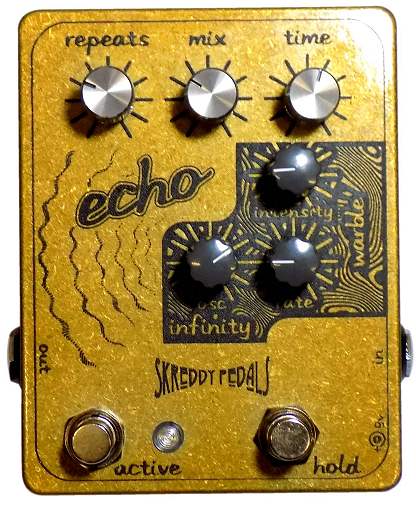
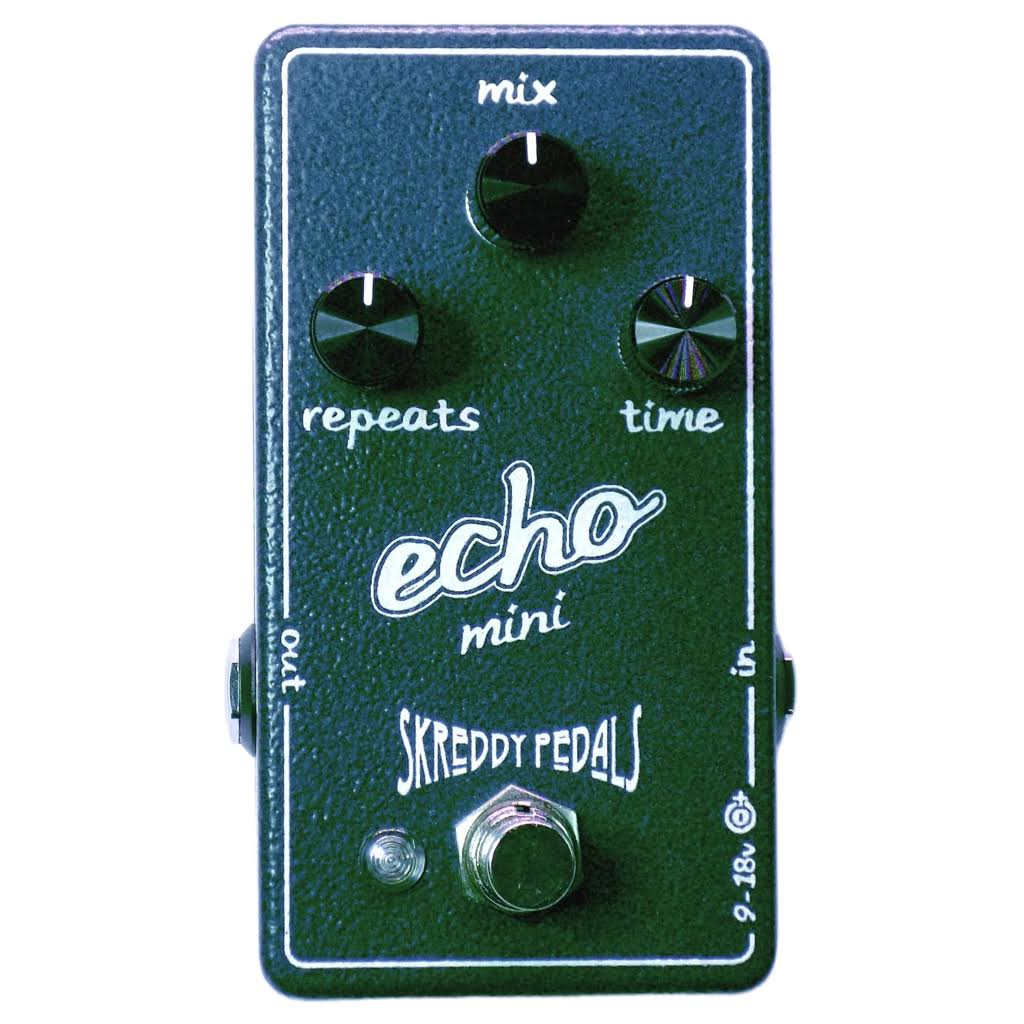
All Skreddy pedals — Echo, Echo Infinity, Echo Mini — ship direct from Carson City, Nevada. Built by hand, one at a time.
Pedals Mentioned in This Article