The Man Who Redefined Heavy Guitar Tone
Billy Corgan's approach to guitar tone is paradoxical: he's obsessed with detail yet famous for brute force. The Smashing Pumpkins' wall of sound isn't one guitar turned up — it's dozens of guitar tracks layered until they become something almost orchestral. Every single one of those tracks has to sound right, because they all end up in the same sonic photograph.
The two tools that built that sound are well-documented. A vintage Stratocaster. A Big Muff Pi. But not just any Big Muff — the right Big Muff for each era. Corgan's tones shifted significantly between Siamese Dream and Mellon Collie and the Infinite Sadness, and understanding that shift is the key to understanding how to replicate what he did.
This guide covers both eras, and the delay unit Corgan was later confirmed to use on his board.
The Foundation: What Every Corgan Rig Shares
Before the eras, a few constants:
- 1973 Lake Placid Blue Stratocaster — Corgan's primary guitar for the peak Pumpkins records. Not stock: the pickups were modified. But the body and neck contribute to the particular resonance on those recordings.
- Marshall stacks — Mostly JCM 800s and Plexis, pushed hard. The amp character underneath the fuzz matters for that "wall" quality: it's not a clean amp broadcasting a pedal, it's a dirty amp getting dirtier.
- Layering — Butch Vig's production technique on Siamese Dream involved recording the same part dozens of times to create composite tracks. The individual guitar sound needs to have the right frequency footprint to sit properly when layered. Thick in the mids, not too scooped.
Both eras are Big Muff territory. The question is which Big Muff.
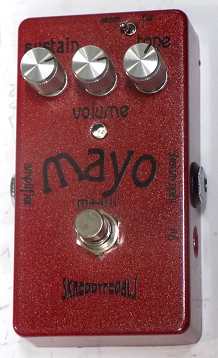
"Siamese Dream" Era (1993) — The Mayo MkIII
Siamese Dream represents one of the great guitar tones in 1990s rock. "Cherub Rock," "Soma," "Today," "Mayonaise," "Silverfuck" — these tracks have a fuzz sound that is simultaneously heavy and melodic, thick but never muddy, with a singing sustain that holds up through even the densest layers.
Billy likely used an opamp version Big Muff, but the cranked amps and recording techniques render more of a pillowy lushness than this particular Big Muff was generally known for.
That's exactly what the Mayo MkIII captures: the heavy, thick, sustaining, aggressive, creamy character.

For Siamese Dream tones specifically: set the Sustain control to about 3 o'clock. Tone around noon. Volume to match or slightly exceed unity. The mid-boost switch is worth experimenting with; engaged, it adds the forward presence that makes individual guitar tracks cut through without needing to be loud.
Corgan's guitar-to-amp setup also contributes. Running into a Marshall that's already breaking up slightly means the Mayo MkIII doesn't have to do all the work alone — it's a fuzz being amplified by a dirty amp, and that combination is richer than fuzz into a totally clean amp.
The Outlier: "Rocket" and the Octave Fuzz
Not every track on Siamese Dream is a Big Muff story. "Rocket" is the exception — that track has a distinctly different character, with a buzzing, upper-octave shimmer sitting on top of the fuzz that isn't a Big Muff trait at all. It's an octave fuzz. Corgan almost certainly used a Univox Superfuzz, or a similar octave-up fuzz circuit, to get that sound. The Superfuzz was a 1970s Japanese pedal that generated an octave-up harmonic alongside the fundamental fuzz tone, creating a biting, synthesizer-like texture that cuts through a mix in a completely different way than any Big Muff variant.
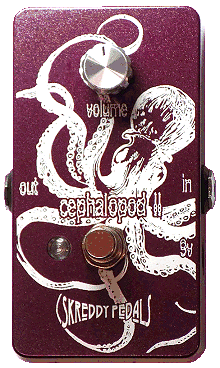
The Cephalopod II is Skreddy's take on that Superfuzz-style circuit — a heavy vintage-style octave-up fuzz with the same chaotic kind of upper-octave character. It's a different beast from the Mayo MkIII: where the Mayo is thick and enveloping, the Cephalopod II adds that clanging octave-up harmonic that makes "Rocket" sound dissonant and other-worldly, especially the intro section featuring a droning open string played alongside high notes on the adjacent string, generating random-sounding overtones.

If you're building a complete Siamese Dream setup, the Cephalopod II handles the songs the Mayo MkIII can't replicate — that octave-fuzz character is a distinct color in Corgan's palette, not just a louder version of the Big Muff sound.
"Mellon Collie and the Infinite Sadness" Era (1995) — The ZERO
Between Siamese Dream and Mellon Collie, Corgan's guitar tones got more aggressive. The double album's heavier tracks — "Bullet with Butterfly Wings," "Zero," "Thru the Eyes of Ruby," "XYU" — have a fuzz sound that is more cutting and articulate than the creamy sustain of the previous record. The midrange is more forward, the attack is sharper, and the overall character is confrontational rather than atmospheric.
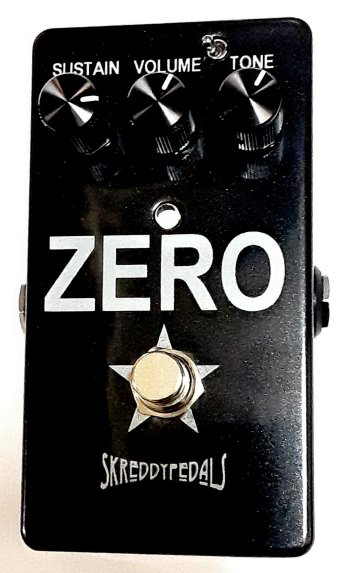
This is the territory of the ZERO. The name fits: this is the most aggressive fuzz in the Skreddy lineup, with high gain that retains note clarity even at maximum sustain. Where the Mayo MkIII is cream and weight, the ZERO is articulation and attack. Chords retain definition, riffs stay clear in the mix, and solos have a cutting forward quality that places them front and center.

For Mellon Collie-era tones: the ZERO's Tone knob is particularly versatile — the full range is usable, unlike many fuzz pedals where only a narrow window works. Start around noon and adjust from there based on your pickup output and amp response. The Sustain control has an incredibly wide usable range; most players end up somewhere between 2 o'clock and full up for the heavy Pumpkins sounds.
The ZERO rewards higher-gain amp settings more than the Mayo MkIII. If you're running into a Mesa Boogie or a JCM 800 with the preamp pushed, the ZERO turns that already-aggressive foundation into something even more relentless — which is exactly what those records are.
Delay and Echo — A Confirmed Skreddy User
Billy Corgan's guitar tone has always involved significant space around it — reverb and delay that turn individual guitar parts into room-filling atmospheres. The vast cathedral reverb on Siamese Dream isn't a separate phenomenon from the fuzz; the fuzz is designed to bloom and sustain into that reverb, and the interaction between the two is what creates the characteristic Pumpkins scale.
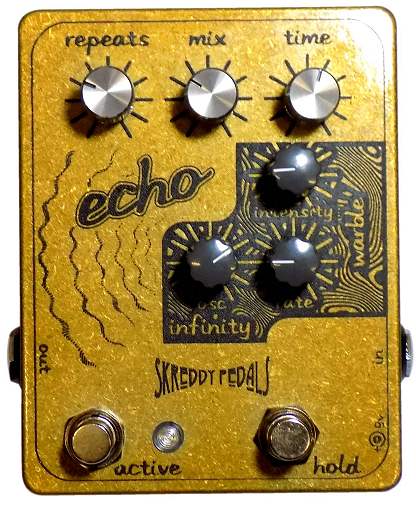
In a Premier Guitar Rig Rundown interview, Corgan was confirmed as a Skreddy Echo user — the same delay circuit that's been part of the Skreddy Pedals lineup for years. This wasn't a subtle mention: the Skreddy Echo was visible on his board as part of his current live setup.
Billy's use of the Skreddy Echo on that particular tour made deliberate use of its warble capability as an effect unto itself.

The Wall-of-Sound Technique
No gear guide for Corgan is complete without addressing the technique, because the technique is the sound. The "wall of sound" isn't a mixing trick applied after the fact — it's built into how the guitars are recorded.
- Record the same part multiple times — Not just left and right, but many times, panned across the stereo field. Each pass has slightly different timing and slightly different pick attack, which creates the thick, organic quality that distinguishes the Pumpkins' layering from digital doubling.
- Use the fuzz's sustain to your advantage — Both the Mayo MkIII and the ZERO have long, singing sustain. Let notes ring fully before the next note or chord change. The sustain carries across layers and creates that continuous, organ-like quality in dense arrangements.
- Don't over-compress — The natural dynamics of the Big Muff circuit, interacting with a driven amp, create their own compression. Adding more compression on top often kills the articulation that makes individual notes recognizable in the stack.
- Reverb goes after the fuzz — In the signal chain, reverb after fuzz creates a bloom effect where the sustained fuzz tail spreads into the reverb. This is the Corgan sound: not a tight guitar with reverb on it, but a diffused, room-filling texture.
Which Pedal for Which Songs?
A quick reference for where to start:
Mayo MkIII: "Cherub Rock," "Soma," "Today," "Mayonaise," "Silverfuck" — anything from Siamese Dream where the fuzz is thick and dreamy rather than confrontational.
ZERO: "Bullet with Butterfly Wings," "Zero," "Thru the Eyes of Ruby," "XYU" — the heavier, more aggressive tracks from Mellon Collie and beyond where attack and articulation matter as much as sustain.
For the full Corgan experience: run either pedal into a slightly overdriven amp, add long trailing delay (Echo Infinity), and stack reverb after the delay in your signal chain.
Explore more on the Big Muff circuit family in our deep dive: The Big Muff Story: From NYC Sidewalks to Your Pedalboard. Or see how David Gilmour uses similar circuits with a completely different technique: How to Sound Like David Gilmour.
Cephalopod II: "Rocket" in which Billy most likely was using a Univox Superfuzz; the Skreddy Cephalopod nails that dissonant sound.
Pedals Mentioned in This Article