The Mix Problem Every Guitarist Faces
You dial in the perfect overdrive sound at home. It's thick, warm, and sounds incredible through your amp. Then you get to rehearsal, the bass player starts thumping, the drummer kicks in, and your carefully crafted tone disappears into the mud.
This is the most common problem in guitar tone, and it comes down to one thing: midrange.
Overdrive pedals that sound "huge" in isolation often sound that way because they boost bass and cut mids. In a band context, it gets lost. Bass frequencies are where the bass player and kick drum live. Mids are where your guitar was supposed to live in the mix. I know that in the living room, this will sound thin and obnoxious; but if you isolate some of your favorite guitar tracks from your favorite songs, that's what you'll hear. The bass is rolled off, and the mids cut through.
The overdrives that cut through a mix are the ones with strong midrange presence, tight low end, and enough harmonic content to occupy their own frequency space. Here are five that do it exceptionally well.
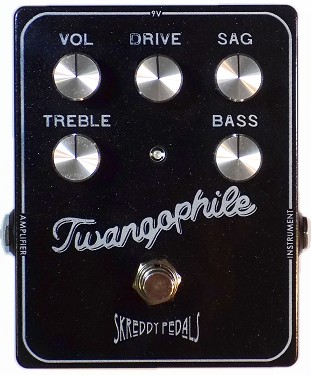
1. Twangophile — Classic, Cutting Country and Blues
The Twangophile bottles the sound of a cranked vintage Fender combo, like brown-face Fender era. This is the sound that fueled Nashville country and Texas blues, and it cuts like a knife, especially with a Telecaster.
Can sound clean or dirty depending on how the Drive control is set. Massive control over treble and bass, but this pedal really lives in the midrange zone, especially when you stack another drive or fuzz into it. Has built-in compression ("Sag") to emulate that sound of a small combo being pushed hard.
Best for: Country, Americana, Surf (you'll need to add your own reverb and tremolo, though).
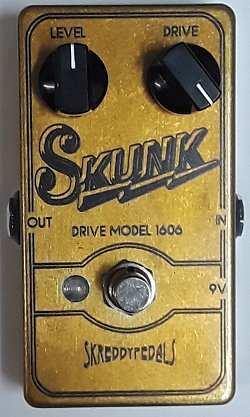
2. Skunk Drive — The Zeppelin Holy Grail
The Skunk Drive delivers that raw, cutting tone of early Led Zeppelin records. Part fuzz, part overdrive, all attitude. It slices through a band mix with authority while retaining note clarity and pick dynamics.
What makes the Skunk Drive special in a band context is its upper-midrange emphasis. It occupies a frequency range that very few other instruments compete for, which means it's audible even at moderate volumes. You don't need to be the loudest thing on stage — you just need to be in the right frequency space.
Best for: Classic rock, blues rock, players who need cutting tone without excessive volume
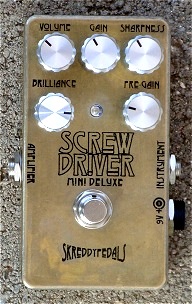
3. Screw Driver — Skreddy's Flagship Overdrive
The Screw Driver was originally designed to be able to get that cutting overdrive sound you can achieve with a Fuzz Face by rolling back the guitar volume. How clean you want it and exactly how far to roll down the guitar volume to accomplish this sound? Always a problem on stage. But with the Screw Driver, you set it, dialed in perfectly, and just stomp on it for that exact sound every time.
The range on this pedal is astounding, from filthy, nasty, sustaining fuzz to tight and bright and twangy. One thing it tends to do is cut through. It has one of the most touch-sensitive responses: play lightly for cleaner, dig in hard for more dirt.
Best for: Really, there's almost nothing this pedal might be inappropriate for.
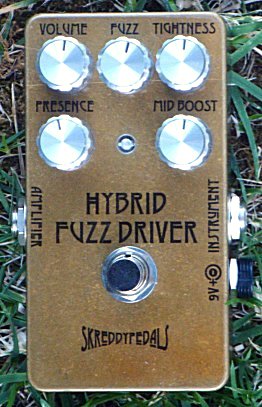
4. Hybrid Fuzz Driver — The Versatile British Crunch
The Hybrid Fuzz Driver captures British amp crunch with remarkable versatility. From edge-of-breakup to high-gain aggression, it responds to your picking dynamics like a cranked amp and has a very bright, cutting sonic profile.
The HFD was the followup to the Screw Driver and the Lunar Module. Where the Screw Driver was designed to work best with single coil pickups and the Lunar centers more on vintage fuzz tones, the Hybrid Fuzz Driver is focused on working great with humbuckers and on emulating cranked amp tones.
Best for: All classic, alt, and heavy rock genres where humbuckers and guitar-volume cleanup are a priority
The Secret: It's About Frequency, Not Volume
The biggest mistake guitarists make is trying to cut through a mix by turning up. Volume wars never end well — everyone turns up, the FOH engineer turns everyone down, and the audience hears mud.
Instead, think about frequency. Your guitar's primary range is roughly 200Hz to 5kHz. The "cutting" frequencies live between 1kHz and 4kHz. Overdrive pedals that emphasize this range — like every pedal on this list — will cut through a mix at any volume.
Pair this with good EQ habits (cut bass on your amp, not boost treble), and you'll be heard in any band context without needing to be the loudest thing on stage.
Pedals Mentioned in This Article